
Gold in 2026: Why It Dropped During War between the US and Iran,Is This the Beginning of a Bigger Fall?
Gold was expected to surge during the recent war،but it dropped instead. Is this the beginning of a major downturn, or just a temporary correction before the next move higher?
Over the past year, gold has been widely recognized as one of the best-performing investment assets globally. Across the Middle East and many other regions, both retail and institutional investors rushed toward gold as uncertainty in financial markets increased. Alongside gold, silver (its long-standing companion) also moved in the same direction, attracting significant attention.
With the recent geopolitical tensions and the escalation involving the United States and Iran, many expected this pattern to repeat itself. The assumption was straightforward: rising global risk should drive gold prices higher.
However, in recent days, gold has entered a corrective phase and experienced a noticeable decline.
This unexpected move has created two opposing perspectives among investors. On one side, some believe this pullback is temporary and that gold is still positioned to reach new highs. They point to continued buying by major central banks as a strong signal that long-term demand remains intact.
On the other side, a growing group of investors argues that market dynamics have shifted. From their perspective, relying solely on gold may no longer be the safest strategy, and it may be time to reconsider asset allocation and explore alternative opportunities.
In this context, the real question is no longer “Will gold go up or down?” but rather:
What is the right decision and how do professional investors approach such moments?
To answer that, we need to go beyond assumptions and examine how gold actually behaves under pressure.
Why Did Gold Price Drop During the US–Iran Conflict?
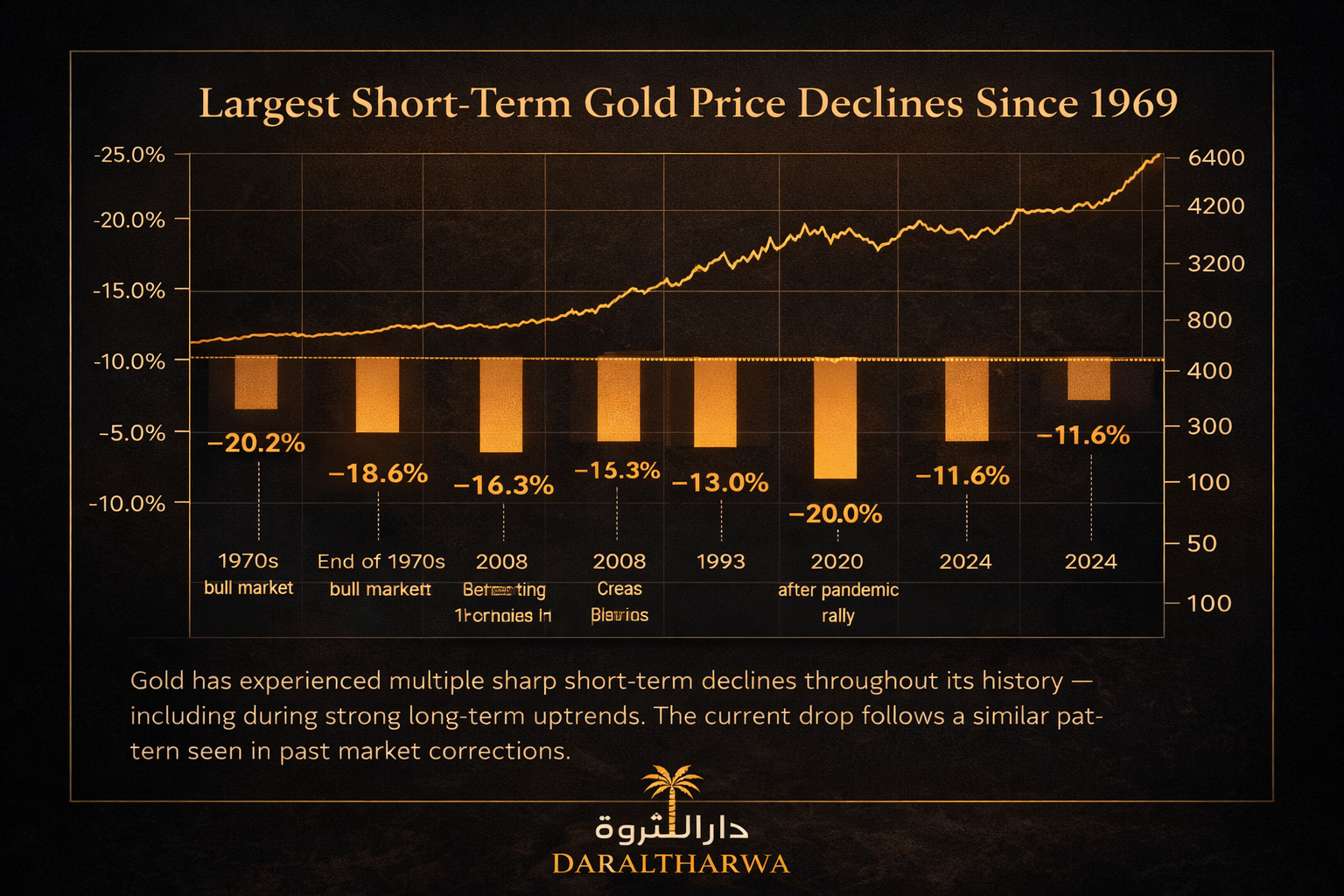
Could this decline actually be the beginning of a larger upward move? Is gold preparing for another rally?
To answer these questions, we first need to understand why gold dropped in the first place. Contrary to common belief, gold’s behavior during geopolitical crises is not driven solely by the presence of conflict, but by how global capital reacts to it.
As is widely known, one of the primary drivers of gold prices is geopolitical risk. When major economies(especially a country like the United States)become involved in conflict, the global economy faces increased uncertainty. Under normal conditions, this should increase demand for gold, as it is traditionally viewed as a safe haven asset.
But what we are witnessing now highlights a more complex reality.
The first key factor behind gold’s recent decline is the strength of the US Dollar Index. During periods of uncertainty, global capital tends to flow toward the most liquid and trusted asset,cash, specifically the U.S. dollar. As demand for the dollar increases, it creates downward pressure on gold, due to their inverse relationship.
The second factor is the rise in US Treasury yields. When yields increase, investors are incentivized to move capital into income-generating assets. Since gold does not provide yield, its relative attractiveness declines, leading to capital outflows.
However, the most overlooked factor is liquidity behavior during the early stages of a crisis.
In the initial phase of a shock, investors are not necessarily searching for the “safest” asset they are searching for the most liquid one. This distinction is critical. As a result, even traditionally safe assets like gold may be sold off temporarily, as investors raise cash, cover losses in other markets, or reposition their portfolios.
This dynamic becomes even more important when considering global energy routes such as the Strait of Hormuz, where disruptions can significantly impact liquidity and market behavior. For a deeper breakdown, read our full analysis on
what happens if the Strait of Hormuz closes.
This pattern is not new. During the 2008 financial crisis, gold initially experienced volatility and short-term declines before entering a sustained upward trend once the broader economic impact became clearer.
This suggests that the current decline in gold is not an anomaly, but rather part of a broader, well-established market behavior:
Sell first → Move to cash → Reallocate later
So, does this mean gold is entering a long-term downtrend?
Not necessarily.
The future direction of gold depends on a set of key macroeconomic variables. If the U.S. dollar remains strong and interest rates stay elevated, gold may continue to face pressure. However, if the global economy slows down, monetary policies shift, or inflation concerns resurface, gold could regain momentum and move higher again.
In other words, gold is not reacting to the existence of war alone.it is reacting to liquidity, interest rates, and macroeconomic expectations.
Professional investors understand this distinction. Instead of reacting emotionally to headlines, they track these underlying drivers and position themselves accordingly.
In the next section, we will explore the possible scenarios for gold in 2026 and whether this asset still holds strong upside potential.
Gold Price Forecast 2026: Will Gold Rise Again?

After analyzing gold’s recent behavior, we arrive at the key question:
Is this decline the beginning of a larger rally, or the start of a deeper correction?
To answer this, we need a scenario-based approach. Gold is heavily influenced by macroeconomic forces interest rates, inflation, liquidity, and monetary policy. Rather than making a single prediction, professional investors evaluate multiple possible paths.
Understanding how these macro factors shape investment decisions is essential, especially when building a
portfolio strategy tailored to changing market conditions, which we explore further in our guide on
personalizing your investment strategy.
Scenario 1: Rate Cuts and a Weaker Dollar (Bullish)
If central banks( especially the Federal Reserve) begin cutting interest rates due to slowing economic growth or recession risks, this could act as a strong catalyst for gold.
In this environment:
- Bond yields decline
- The dollar weakens
- Capital flows back into gold
Historically, this has been one of the most powerful drivers of gold rallies.
Scenario 2: Higher-for-Longer Rates and a Strong Dollar (Current Base Case)
At present, monetary policy appears to be leaning in this direction. The Federal Reserve has kept interest rates elevated, and market expectations suggest a continued “higher-for-longer” stance, with even the possibility of further tightening if inflation persists.
This has been one of the key reasons behind the recent pressure on gold.
In this scenario:
- The US Dollar Index remains strong
- Bond yields stay elevated
- Capital shifts away from non-yielding assets like gold
As a result, gold may remain under pressure in the short term or move in a sideways, volatile range rather than a strong uptrend.
Scenario 3: Stagflation and Escalating Crises (Explosive Upside)
Another critical scenario to consider is the possibility of stagflation a combination of slowing economic growth and persistent inflation.
In such an environment:
- Economic growth weakens
- Inflation remains elevated
- Policy responses become more constrained
At the same time, geopolitical tensions (particularly in energy-sensitive regions) could push commodity prices significantly higher. In extreme cases, some analyses suggest that oil prices could surge toward $200 if disruptions intensify.
This dynamic is closely tied to broader global market reactions, as explained in our analysis on
oil war scenarios and global investment strategy.
If this scenario unfolds:
- Global costs rise sharply
- Market uncertainty increases
- Demand for safe assets like gold accelerates
This is typically the type of environment where gold experiences strong, accelerated upward moves.
Central Bank Demand: A Strong Signal, but Not a Trigger
One of the most important supporting factors for gold in recent years has been aggressive central bank buying.
Countries such as China, Poland, Kazakhstan, and Brazil have been among the largest accumulators of gold reserves. Other countries—including Malaysia, the Czech Republic, and several emerging economies have also increased their allocations.
This trend reflects a broader strategic shift: reducing reliance on the U.S. dollar and strengthening reserve diversification.
However, it’s important to understand that:
- Central bank demand is a long-term structural signal
- It does not necessarily drive short-term price movements
Short-term dynamics are still dominated by interest rates, liquidity, and capital flows.
Conclusion: Will Gold Go Up in 2026?
The realistic answer is:
✔ Yes—gold still has upside potential
❗ But not with the same speed and momentum seen in the previous year
Gold may continue to rise in 2026, but:
- Its performance will be highly dependent on monetary policy
- Volatility is likely to remain elevated
- A simple “buy gold” strategy is no longer sufficient
The market has entered a phase where allocation matters more than direction.
So the next question becomes critical:
If gold is no longer the only safe choice, what role should it play in your portfolio?
To better understand how to structure your investments in such conditions, you can explore our guide on
building a successful investment portfolio in changing market environments.
Should You Hold Gold in Your Portfolio in 2026?

After reviewing the scenarios, we arrive at a practical and essential question:
Should you include gold in your portfolio in 2026?
The short and clear answer is:
Yes, but not with the same mindset that dominated last year.
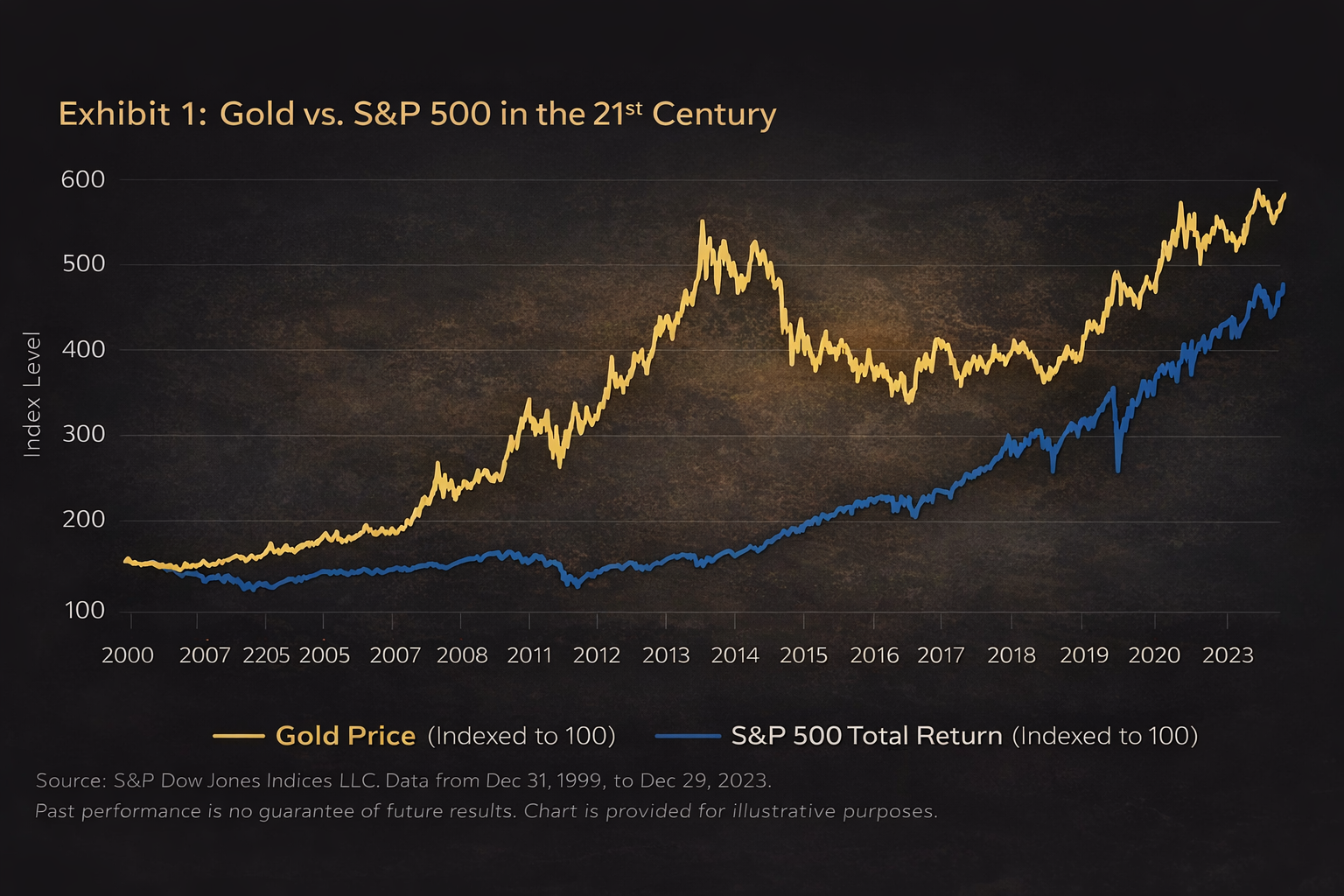
Over the past year, as gold delivered strong returns, many investors entered the market believing gold was a growth asset capable of driving wealth creation on its own.
But this is a misconception.
Gold is fundamentally a hedge asset, not a growth engine.
Understanding this distinction is critical.
The Real Role of Gold in a Portfolio
Gold is not designed to generate the highest returns. Its primary role is to protect capital during periods of stress.
Specifically, gold tends to perform when:
- Equity markets decline
- Economic uncertainty rises
- Inflation accelerates
In this sense, gold acts as a stabilizer within a diversified portfolio.
This is why completely removing gold from a portfolio is typically considered a non-professional decision.
To better understand how to structure a balanced portfolio in different market conditions, you can explore our guide on
building a successful investment portfolio in Dubai.
How Much Gold Should You Hold?
There is no universal answer.
The appropriate allocation depends on individual factors such as:
- Age
- Income stability
- Financial goals
- Risk tolerance
However, a general framework can be considered:
✔ If you are closer to retirement:
- Capital preservation becomes the priority
- A higher allocation to gold may be appropriate
✔ If you are younger with long-term growth objectives:
- You can tolerate more risk
- A lower allocation to gold and higher exposure to growth assets may make sense
✔ If your income is unstable or risk exposure is high:
- Gold can serve as a financial buffer
In many portfolio strategies, an allocation of 5% to 15% to gold is commonly used. However, this is not a fixed rule and should be tailored to individual circumstances.
A Common Mistake Investors Make
One of the most frequent mistakes is treating gold as a growth asset.
In reality:
- Gold is for wealth preservation
- Not for aggressive growth
When investors misunderstand this, they often buy at market highs and panic during corrections.
A Professional Perspective on Gold in 2026
In 2026, gold still deserves a place in a portfolio—but not as the dominant asset.
Instead, it should be:
- Part of a diversified allocation strategy
- Used to balance risk, not define the entire portfolio
Professional investors integrate gold alongside other asset classes to optimize risk-adjusted returns.
Practical Takeaway
To put it simply:
✔ Do not eliminate gold from your portfolio
✔ Do not over-allocate to it
✔ Understand its role: protection, not acceleration
If You Need Guidance
The optimal allocation to gold varies for each individual.
If you want a tailored portfolio aligned with your financial goals, risk profile, and market conditions, you can consult with Daraltharwa for a personalized strategy.
If Not Gold, Then What? Where Smart Money Is Moving in 2026
Now that we understand the true role of gold in a portfolio, the next critical question is:
If gold alone is not enough, where should capital be allocated in 2026?
The reality is that today’s market is no longer about finding a single “best asset.”
It’s about identifying where capital is flowing and why.
In 2026, smart money is moving toward areas that either benefit directly from current conditions or have become undervalued due to short-term fear.
1. Equities _ Opportunity in Temporary Weakness
One of the most attractive opportunities right now lies in selected equities.
Due to geopolitical tensions and market uncertainty, parts of the stock market have experienced mild corrections. However, in many cases, these corrections have created compelling entry points.
For example:
- Alphabet
- Meta Platforms
These companies:
- Have strong fundamentals
- Generate consistent cash flow
- Operate in sectors with long-term growth potential
👉 Key insight:
Unlike gold, equities are where real wealth creation happens.
Professional investors understand that market fear often creates the best buying opportunities.
2. Energy _ Direct Beneficiary of Geopolitical Tension
In the current environment, one of the clearest capital flows is moving into the energy sector.
With rising geopolitical tensions:
- Supply risks have increased
- Oil prices are trending upward
- Energy markets are gaining investor attention
One of the most critical pressure points is the Strait of Hormuz, a key global oil corridor.
👉 For a deeper understanding of this dynamic, you can refer to our detailed analysis on what happens if the Strait of Hormuz closes and its impact on global markets.
As long as tensions persist:
- Energy-related equities can continue to outperform
- Oil & gas companies remain strategically positioned
👉 This is one of the most direct macro-driven opportunities in today’s market.
3. Real Estate _ Not a Priority in the Current Phase
Unlike previous cycles, real estate—particularly in regions exposed to geopolitical risk—is currently not a priority.
Given:
- Regional instability
- Shifting capital flows
- Increased investment uncertainty
Entering real estate markets at this stage can carry elevated risk.
Until stability returns, this asset class remains secondary.
4. Bitcoin _ A Secondary, High-Risk Opportunity
Bitcoin has recently experienced significant volatility and sharp corrections.
While this has pushed many investors out of the market, it may also be setting the stage for a future recovery.
Important perspective:
Bitcoin is not a primary allocation right now.it is a tactical, high-risk component.
It can:
- Represent a small portion of a portfolio
- Offer upside if market conditions improve
But:
- It remains highly volatile
- And should not be viewed as a replacement for gold
The Key Shift: Stop Looking for a “Replacement”
One of the biggest mistakes investors make is trying to replace one asset with another.
In reality:
❌ There is no direct replacement for gold
✔ There is only smart portfolio construction
To better understand how to build a resilient investment structure, you can explore our guide on
personalizing your investment strategy based on market conditions and individual goals.
Professional investors in 2026 are not asking:
“What should I buy instead of gold?”
They are asking:
“How should I structure my portfolio given current conditions?”
Final Insight: Portfolio Over Prediction
Your portfolio should never be static.
It must:
- Adapt to market conditions
- Reflect your financial goals
- Evolve with global trends
Asset weights change over time:
- Sometimes equities take the lead
- Sometimes energy dominates
- Sometimes defensive assets like gold matter more
This is not inconsistency, this is professional portfolio management.
Final Takeaway
In 2026:
- Opportunities still exist
- But not in a single asset
The investors who win are those who:
- Understand market structure
- Stay flexible
- And build balanced, adaptive portfolios
Need a Clear Strategy?
There is no universal allocation that works for everyone.
Your optimal portfolio depends on:
- Your income and risk exposure
- Your financial goals
- Your time horizon
If you want a clear, personalized strategy tailored to your situation, you can reach out to Daraltharwa.
We help you:
- Structure your portfolio intelligently
- Adjust allocations based on real market conditions
- And make decisions with clarity، not emotion
Most investors lose money not because of the market—but because of poor structure.


.svg)


